
The U.S. Environmental Protection Agency (EPA) collects data on some toxic chemicals from what some industries estimate that they release into the environment each year. This data makes up the Toxic Release Inventory (TRI) database.
- Pennsylvania TRI Statistics
- Where to Find TRI Information
- Online Toxics Resources
- What TRI Means (What Is and Isn’t Reported)
- TRI Reporting Expansion: Info From 7 New Industries now Available
- Risk Management Plans: Learn more about Chemical Hazards in Your Community
- Coal & Oil Electric Utilities Are Major Polluters
 | 
|
In the new release of 1998 Toxic Release Inventory data, there are 7 new industries reporting. 6 of the 7 exist in Pennsylvania (only metal mining is not an issue in PA).
|
Where to Find TRI Information
There are now 3 main sources for Toxic Release Inventory data: the U.S. EPA, the Right to Know Network, and the Scorecard website.
|
Based on 2001 Toxic Release Inventory data, Pennsylvania ranks…
- #1 in air release of metals and metal compounds (2,698,236 lbs in 2001) [see the data], and #2 in total off-site releases of metals [see the data]
- #5 in total air emissions of all chemicals (OH, NC, TX, GA, PA) [see the data]
- #3 in direct discharges and estimated sewer discharges of toxic chemicals (TX, IN, PA) [see the data]
- #2 in shipping toxic chemicals off-site (to dump or treat them in other communities) (IN, PA) [see the data]
- #4 in releases of dioxin pollution into the air [see the data] (Note: the now-closed Harrisburg incinerator would have made PA #1 if incinerators were required to report to the TRI database.)
- In the manufacturing sector, Pennsylvania industries rank:
- #2 in off-site releases (IN, PA)
- #3 in surface water discharges (TX, IN, PA)
- #12 in on-site releases
- #13 in air releases
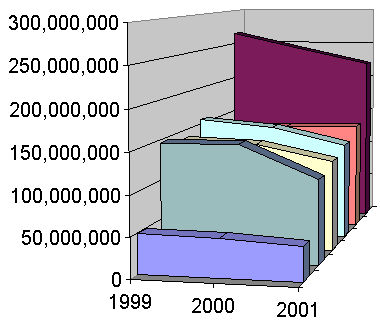
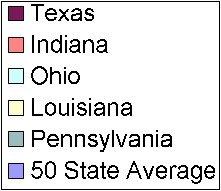
- #5 in total releases (TX, IN, OH, LA, PA) [see the data]
- Among coal and oil-fired electric utility power plants, Pennsylvania ranks:
- #1 in releases of mercury pollution. In 2001, these power plants reported releasing the 3rd highest amount of mercury pollution into the air (behind Texas and Ohio), the 2nd highest amount to waterways (behind Kentucky), the highest amount to land, and the most mercury overall. [see the data] Reliant Energy’s Keystone Power Plant in Armstrong County releases more mercury than any other power plant in the nation (1,800 pounds of mercury in 2001).
- #3 in air emissions. [see the data] In 2001, Pennsylvania’s coal and oil-fired power plants reported releasing 59,026,821 pounds of toxic pollution into the air and 76,491,861 pounds of total toxic releases, ranking 3rd highest behind North Carolina and Ohio. These utilities reported more toxic chemicals being contained and transfered to other communities (11,668,996 pounds) than any other state.
- #1 in dioxin air pollution. In 2001, Pennsylvania’s coal and oil-fired power plants reported releasing 176.57 grams of dioxin pollution into the air, more than any other state. [see the data] The Cambria Cogen power plant in Cambria County releases more dioxin and dioxin-like compounds than any other fossil-fueled power plant in the nation.
- #3 in toxic air emissions from the coal mining industry (WV, KY, PA) [see the data]
- #4 in air emissions of HAPs (hazardous air pollutants) [see the data]
- #4 in total off-site releases of Persistent, Bioaccumulative, and Toxic Chemicals [see the data] and #4 in air emissions of these toxins [see the data]
- #4 in total off-site releases of OSHA-listed carcinogens [see the data]
- #5 in air emissions of OSHA-listed carcinogens [see the data]
| New Industries Reporting to TRI | Pennsylvania Distinguishments |
|---|---|
| Coal Mining/Processing |
|
| Electric Utilities (coal/oil) |
|
| Petroleum Bulk Terminals |
|
| Chemical Wholesalers |
|
| Metal Mining | PA doesn’t have this sort of industry |
| Solvent Recovery Operations | These 2 categories are combined in EPA’s reports so far.
Primarily due to Westmoreland County’s Mill Service, Inc., PA is: |
| Hazardous Waste Treatment, Storage, & Disposal (TSD) Facilities |
Here’s a break down (all numbers are in pounds):
Coal Mining/Processing:
PA has 4 mining operations among the nation’s top 25 mining industry toxic releasers:
PA ranked #2 in Air Emissions behind West Virginia:
- WV 1,368,089 PA 36,853
PA ranked #5 in Non-Landfill On-Site Land Releases:
- NM 5,620,000 IL 2,708,418 CO 1,592,748 AL 975,000 PA 281,695
PA ranked #6 in Total On-Site Releases:
- NM 5,620,000 IL 2,715,041 WV 1,791,466 CO 1,593,746 AL 1,030,087 PA 318,563
Electric Utilities Burning Coal or Oil:
Pennsylvania had 2 coal plants among the nation’s top 25 Electric Utility Toxic Releasers:
PA ranked #3 in Total Air Emissions from Electric Utilities:
- OH 95,220,630 WV 62,340,588 PA 58,894,300
PA represents 7.5% of the total U.S. air emissions from coal/oil electric utilities (58,894,300 out of 783,686,372).
PA is #4 in Total On-Site Releases:
- OH 109,616,575 WV 73,922,872 FL 66,192,582 PA 64,767,536
PA is #2 in Total Off-Site Transfers:
- ND 11,302,469 PA 8,416,171
PA is #3 in Total On and Off-Site Releases:
- OH 113,923,643 WV 75,881,813 PA 73,183,707
PA is the ONLY State to use underground injection in Class II-V wells for Electric Utility wastes: 160,800 pounds in 1998. The only other state to use underground injection wells for coal/oil utility waste disposal is West Virginia (18 pounds in Class I wells).
PA is #14 in surface water discharges from electric utilities.
PA is one of only 4 states disposing of electric utility wastes in RCRA Subtitle C Landfills (we’re #2 after Florida).
Petroleum Bulk Storage Terminals:
PA has one petroleum bulk terminal among the nation’s top 25 petroleum bulk terminal toxic releasers:
PA is #3 in Surface Water Discharges:
- VA 113,127 MA 9,468 PA 2,149
PA is #6 in Total Air Emissions:
- TX 522,883 CA 470,307 NY 302,030 NJ 296,064 MA 237,434 PA 216,632
PA is #7 in Total On-Site Releases:
- TX 525,941 CA 472,422 NY 302,857 NJ 296,601 MA 246,902 VA 240,494 PA 218,781
PA is #7 in Total On and Off-Site Releases:
- TX 530,011 CA 496,843 NY 325,122 NJ 310,138 MA 286,910 VA 244,556 PA 222,023
Chemical Wholesalers:
PA is #10 in Total On and Off-Site Releases:
- TX 240,952 OH 186,800 NJ 151,584 CA 120,126 NC 115,685 FL 84,102 MO 65,725 IL 53,379 LA 46,189 PA 43,023
RCRA Hazardous Waste Treatment, Storage, and Disposal (TSD) Facilities & Solvent Recovery Operations
|
Success Stories – the TRI spotlight leads the worst facilities to improve.
In 1998, Mill Service’s (now Max Environmental) massive pollution pushed Pennsylvania into top positions for 2 types of discharges (when compared to ALL industries combined!). Mill Service was the main reason that Pennsylvania was #1 in Surface Water Discharges (556,760 lbs in 1998). They were more than 1/3rd of the reason that PA was #6 in on-site releases and in total releases (12,833,464 lbs in 1998). Mill Service was the entire reason that PA was #2 in Non-Landfill Land Releases next to Oregon. AK Steel |
PA has one hazardous waste TSD facility among the nation’s top 25 TSD toxic releasers:
Mill Service is the nation’s only hazardous waste treatment facility with open-air waste mixing lagoons. It’s one of the most disgraceful facilities scarring Pennsylvania’s land. The Concerned Residents of the Yough (CRY) had organized against Mill Service for years.
Mill Service represents the majority of Pennsylvania’s on-site toxic releases in this TRI category. Here’s what they reported for 2001:
- Total Air Emissions 1,260 Surface Water Discharges 503 RCRA Subtitle C Landfills 246,600 Surface Impoundment 722,600 Total On-Site Releases 1,941,926 Off-Site Releases/Transfers Off-Site for Disposal 45,800 Total On and Off-Site Releases: 1,987,726
1997 Figures
| Map of PA manufacturing facilities reporting to the 1997 Toxic Release Inventory |
The following are some of the 1997 figures for reference. 1998 data for some of these won’t be available until EPA releases more complete 1998 data in June 2000.
Pennsylvania was #1 in Off-site Releases/Transfers
- Pennsylvania 63.3 million lbs Ohio 45.5 million lbs Indiana 44.6 million lbs
Pennsylvania facilities reported 63.3 million pounds of off-site releases (transfers off-site to disposal, including transfers of metals and metal compounds to solidification/stabilization, treatment, and sewage treatment plants). Ohio ranked second with 45.5 million pounds, closely followed by Indiana with 44.6 million pounds. Nearly half (44.2%) of Pennsylvania’s total releases were transferred off-site for disposal, as were more than one-quarter (28.7%) of Ohio’s and more than one-third of Indiana’s (36.4%).
Looking at the flow of these transfers across state lines, Pennsylvania was the 2nd largest exporter of toxic chemicals (down from #1 in previous years).
Pennsylvania ranked first for projected increase in production-related waste, from 917.9 million pounds in 1997 to 1.01 billion pounds in 1999, the only projected increase exceeding 100 million pounds. Pennsylvania’s projected 10.4% increase from 1997 to 1999 compares to an 8.4% increase for 1996 to 1997.
Pennsylvania was #3 in surface water discharges in 2001 (TX, IN, PA)
–>
Online Toxics Resources
- Right-To-Know Network
- Mapcruzin.com (Clary-Meuser Research Network)
- Toxic Chemicals and Environmental Health (includes pollution-mapping projects)
What TRI Means (What Is and Isn’t Reported)
The Toxic Release Inventory only serves to give us a glimpse of the tip of the iceburg of toxic chemicals in our environment. Here are some of the limitations of the TRI:
Facilities must report their releases of a toxic chemical to TRI if they fulfill four criteria:
- They must be in one of 20 manufacturing sectors (SIC code in 20-39) or must be among 6 other sectors (metal mining; coal mining; coal or oil-fired electric utility power plants; commercial hazardous waste treatment, chemical wholesalers; petroleum bulk terminals; and solvent recovery services);
- They must have the equivalent of 10 full-time workers (40-50% of facilities in the above categories are exempt based on this criteria);
- They must either manufacture or process more than 25,000 lbs of the chemical or use more than 10,000 lbs during the year (unless the chemical is a persistent bioaccumulative chemical); AND
- The chemical must be on the TRI list of 582 specific toxic chemicals and 30 chemical groups (out of about 80,000+ chemicals in industrial use*).
Source: http://www.rtk.net/triabout.html * The EPA estimated in 1980 that more than 70,000 different chemicals were being manufactured in the U.S., with some 1,000 new chemicals being added each year. -Joseph Petulla, American Environmental History (Columbus, Ohio: Merill Publishing Company, 1988), 428.
Read more about the limitations of TRI from the Scorecard website.
The following is excerpted from writings of Michael Meuser, an environmental sociologist in California who does a lot of work with computer mapping of TRI facilities:
There are a few things to think about when considering incremental increases or decreases in TRI releases between years.
- We do not start from zero again each year. Our air, land, water – our own bodies and all other living things do not become magically toxic free – somehow renewed on January 1 of each year. To some degree there is a cumulative effect that spans years. Toxic chemicals accumulate in the air, land, water, our bodies and the bodies of living things year after year. The Cumulative Exposure Project (CEP) is a beginning at accounting for the way that these toxic chemicals accumulate. One can quibble over a little more or a little less, but looked at in these terms, any TRI release, whether it’s a little lower or a little higher than the previous year, is an INCREASE to some yet fully known degree.
- TRI releases account for only a small amount of toxic chemicals. The list of TRI chemicals includes 600-some chemicals. The TRI is self-reported and there are rules that allow many facilities to avoid reporting. The list of High Production Volume (HPV) chemicals includes over 2,000 chemicals. There are over 80,000 chemical in production. TRI accounts for little of this.
- TRI so far only accounts for chemicals released or in waste, NOT all chemicals used in production. Several years ago President Clinton directed EPA Administrator Browner to develop a plan for accounting for the chemicals used in production – a cradle-to-grave accounting. But the last mention of this by EPA was in 1996. The Pre-Publication Version (9/25/1996) of 40 CFR Part 372 says, “EPA intends to expand its Community Right-to-Know initiatives to increase the information available to the public on chemical use.” But the final version (July, 1998) makes no reference to “chemical use” whatsoever. Chemical use reporting is a dead issue.
“Worst Case Scenarios” have the promise of providing us a more complete accounting of the toxic chemicals in our communities and for the beginnings of a nationwide toxic accounting, but Congress and the Whitehouse are attempting to cripple full disclosure of this data, mandated by the Clean Air Act, saying that to fully disclose the information would increase the likelihood of terrorism. Apparently they have determined that since the 66,000 facilities in the U.S. that must report their worst case scenarios to EPA increasingly are targets for terrorism – timebombs in our neighborhoods – it is in our best interest to know less, not more, about the effects of such a terrorist attack on one of these facilities – a potentially Bhopal-like catastrophe.
Michael R. Meuser http://www.mapcruzin.com/
Additional info on the 1998 TRI data and chemical hazards can be found in the following article on the mapcruzin.com website: 1998 TRI Releases TRIPLE! — Children at Risk to Neurotoxins
TRI Reporting Expansion: Info From 7 New Industries now Available
Working Group on Community Right-to-Know 218 D Street, SE * Washington, DC 20003 Phone: 202-544-9586; Fax: 202-546-2461
Press Release May 11, 2000
Contacts:
Lois Gibbs      Center for Health, Environment and Justice (703) 237-2249
Felice Stadler  Clean Air Network                          (202) 289-2403
Lois Epstein    Environmental Defense                      (202) 387-3500
Alan Septoff    Mineral Policy Center                      (202) 887-1872
Becky Stanfield US P.I.R.G.                                (202) 546-9707
Lisa Mosca      Working Group on Community Right-to-Know   (202) 544-2714
Paul Orum       Working Group on Community Right-to-Know   (202) 544-9586
EPA RELEASES NEW POLLUTION DATA
MINES, UTILITIES AND TOXIC LANDFILLS RANK HIGH
ACTIVISTS CALL FOR POLLUTION SOLUTIONS AND FULL DISCLOSURE
Today the Environmental Protection Agency is releasing new national data on toxic pollution from the Community Right to Know Act’s Toxics Release Inventory (TRI). For the first time, the inventory covers the immense toxic pollution released from mines and utilities, and the quantities dumped into hazardous waste landfills.
“Disclosing these emissions is an important citizens’ victory that will help people organize to clean-up and prevent toxic pollution,” said Paul Orum, director of the Working Group for Community Right-to-Know.
For its first ten years, the inventory covered only manufacturing industries. The data released today by EPA covers seven additional industries: metal mines, toxic waste disposal, utilities that burn oil or coal, chemical wholesalers, coal processors, petroleum bulk storage terminals, and solvent recyclers.
These new industries report large amounts of toxic pollution, making gaps in regulatory coverage more apparent. Here’s what public interest leaders are saying:
“The new TRI data show that hardrock mining creates huge amounts of toxic pollution. Congress should end the mining industry’s current exemption from toxic waste laws, and reject attempts to legally allow more dumping of toxic mine waste,” said Alan Septoff of the Mineral Policy Center.
“Electric utilities are major toxic polluters. EPA should close the special loopholes that exempt utilities’ toxic air releases and coal combustion waste from strict regulation under federal law,” urged the Clean Air Network’s Felice Stadler.
“The immense amount of toxics dumped into landfills shows the need for pollution prevention at the source,” said Lois Epstein of Environmental Defense.
“For grassroots environmental groups across the country, expanding the Toxic Release Inventory to include more industries is a start, but to protect our communities we need to reduce the use of toxic chemicals,” said Lois Gibbs of the Center for Health, Environment and Justice. “Citizens not only want to know how much pollution is being released into their communities, they want facilities to prevent releases in the first place.”
“To promote pollution prevention, industries should track and report toxic chemical uses, not just releases,” said Becky Stanfield of U.S. PIRG. “States that collect chemical use information are reducing production waste, contrary to the national trend,” Stanfield said. “President Clinton should require federal facilities to track and report toxic chemical use. This would make the federal government a pollution prevention leader and leave a lasting right-to-know legacy.”
“Unfortunately, the Administration is considering proposals that threaten the future of public right-to-know about toxic pollution. We are very concerned about any proposal that weakens the public right-to-know,” said Lisa Mosca of the Working Group. “We should close current loopholes, not create new ones.”
The Emergency Planning and Community Right to Know Act passed in 1986 as part of Superfund, the nation’s toxic dumpsite cleanup law. The data released today covers the 1998 reporting year, and while incomplete, is nonetheless the best information available to the public on toxic pollution in many communities across the country.
* * *
This release is provided by the Working Group on Community Right-to-Know, a national network of activists concerned with the public’s right-to-know about chemical hazards and toxic pollution.
For more information contact (phone numbers above):
- Mining pollution — Mineral Policy Center
- Utilities pollution — Clean Air Network
- Toxic waste and communities — Center for Health, Environment and Justice
- Toxic waste regulation — Environmental Defense
- Pollution prevention — U.S. PIRG
- Phantom reductions–Working Group on Community RTK
EPA is releasing the national 1998 TRI data today at www.epa.gov/tri/
Additional environmental databases are available through the Right-to-Know Network (RTK-NET) at www.rtk.net
–END–
Risk Management Plans: Learn more about Chemical Hazards in Your Community
Beginning in 1999, the Clean Air Act requires many chemical-using industries to disclose worst-case accident scenarios as part of larger Risk Management Plans. Below are a few good websites for checking out this information:
- Worst Case Scenario links, articles, maps
- Spills & Emergencies <!–
- RTK Net Worst Case Scenarios
- Key Questions for a Chemical Company Near You –>
- Search Risk Management Plans on the RTKnet website
Coal & Oil Electric Utilities Are Major Polluters
1998’s Toxic Release Inventory was the first set of data available on toxic emissions from coal and oil burning electric utilities.
Nationwide, the chemicals that contributed the most to the electric utility sector’s total releases were hydrochloric acid, barium compounds, and sulfuric acid. The majority of the releases of hydrochloric acid and sulfuric acid were to air and the majority of the releases of barium compounds were to land on-site. In 1998, these three chemicals made up 79.2% of the total releases for the electric utility sector. (Note that some chemicals which the electric utilities release in significant quantities, SOx, NOx, and CO are not on TRI.)
Most of the releases from electric utilities are the result of burning coal or oil to generate electricity. Both coal and oil contain metals that are released to the air when the fuel is combusted. These metals include barium, copper, chromium, manganese, lead, nickel and zinc. Other chemicals formed during combustion include hydrochloric acid, sulfuric acid, and hydrogen fluoride. The ash that remains after coal is combusted will also contain metals. Large quantities of this ash may be disposed of in on- or off-site landfills, or returned to coal mines for disposal there.
The electric power industry is the largest single contributor to air pollution, due to exemptions in the Clean Air Act on controls of smog and acid rain forming pollutants. The TRI shows that they have some of the largest toxic chemical releases to the environment.
ELECTRIC UTILITIES AND THE 1998 TOXICS RELEASE INVENTORY TALKING POINTS
What’s New About The 1998 Toxics Release Inventory?
This year for the first time the Toxics Release Inventory will include releases to the land, water, and air from coal and oil burning electric power plants.
Why Didn’t Utilities Have To Report Under TRI In The Past?
Originally the TRI required only manufacturing companies to report their annual toxic releases. However, in 1997 a coalition of public interest groups convinced EPA to add seven non-manufacturing industries based on information that they were major sources of toxic pollution. Electric power was one of those industries.
What Power Plant Pollutants Are Reported Under The TRI, And What Are The Health Impacts Of These Pollutants?
Power plants have to report their releases of a number of toxic compounds. These include acutely toxic gases like hydrochloric acid, sulfuric acid and hydrogen fluoride as well as metals like chromium, lead, and barium, that can be emitted as fine particles. Power plants also release heavy metals like chromium, arsenic, and nickel through combustion waste that can leach
into surface and groundwater. Mercury is released directly into the air and also onto land as combustion waste (although mercury was mostly not reported to the 1998 TRI-see below).
Over 21 million Americans live within five miles of a coal plant. Exposure can occur from breathing contaminated air, drinking contaminated water, eating contaminated fish and other foods. Lead and mercury are well-known developmental toxins, while arsenic is a carcinogen. EPA lists less than 1% of the 70,000 synthetic chemicals used in the market.
For example, excess cancer risks for children drinking groundwater contaminated with arsenic from power plant wastes have been found to be as high as one-in-one hundred — ten thousand times higher than EPA’s regulatory goal of reducing cancer risks to less than one-in-one million.
What Do The 1998 TRI Releases From Electric Utilities Tell Us?
Toxic releases from coal and oil burning power plants are immense, making them one of the largest sources of toxic pollution in the U.S. Each year
they release millions of pounds of heavy metals and toxic acid gases into the environment, nearly all of which is unregulated.
How Does The Electric Utility Industry Compare To Other Major Industries That Are Required To Report To The TRI?
In states where the 1998 TRI reports have already been released to the press, electric utilities are surpassing many manufacturing companies in total toxic chemical releases. They are either the new number one source of toxic pollution, or close to number one. For example, in Virginia, coal-fired plants hold six of the top ten toxic polluter slots.
How Accurate Is The Data Reported To The TRI?
The release data reported to the TRI is based on industry estimates, not actual monitoring. Also, given the reporting thresholds, not all releases are being reported. For example, mercury releases are not included in the 1998 TRI although we know that they release (to the air and land) nearly 200,000 pounds of this toxic metal annually. (Mercury releases will be in the 2000 TRI, which won’t be publicly available until Spring 2002 – EPA lowered the reporting threshold for mercury and several other persistent, bio-accumulative toxic compounds starting with the 2000 reporting year.)
Nevertheless, while the TRI may not tell us the whole story, it is the only publicly available data on toxic chemical releases from electric utilities.
Why Is The TRI Data From Electric Utilities Important?
It confirms what we already know, that coal and oil are dirty fuels. And it begs the question: Why isn’t this industry regulated for its toxic releases?
What Should Be Done About Utilities’ Toxic Releases?
EPA can significantly reduce the human health and ecological impact of utilities’ toxic chemical releases. EPA has the authority to regulate toxic air emissions and toxic coal combustion waste. To date, they have failed to do either, and this needs to change.
By December 2000, the EPA must determine whether to control air toxics emissions from power plants. On April 3rd, 280 citizens’ organizations representing 36 states delivered a letter to EPA Administrator Carol Browner urging the agency to regulate toxic air emissions and coal combustion waste immediately. Caving to industry pressure, the Administration recently decided against regulating coal waste under federal solid waste laws despite the concerns of scientists within EPA that the wastes are hazardous and pose a potential threat to public health.
Last modified: 15 February 2004
http://actionpa.org/tri/